Service Dog Tasks and the Public Access Test, Explained
This page explains the law in general terms. It is not legal advice. For a specific situation, contact the agency listed on this site or an attorney.
Two ideas come up again and again when people plan to train a service dog: the tasks the dog performs, and the public access test. They are related, but they are not the same thing, and neither works the way many people assume.
This guide walks through how to identify a real task, how to train toward it, and how to use a public access test as a practice benchmark. It also explains where South Dakota law fits in.
The short version
- Under the ADA, a service animal is a dog that has been individually trained to do work or perform tasks for a person with a disability (ADA.gov Service Animals FAQ).
- The task must relate directly to the person's disability. Comfort or companionship alone does not meet that test.
- A public access test is a training benchmark. It is not a legal requirement under the ADA, and no official registry or certification exists.
What you need before you start
You do not need to buy special gear to begin. Most of the preparation is clear thinking and good record keeping.
- A written list of the disability-related needs you want the dog to help with.
- A dog with a stable, friendly temperament and good health. Ask your own veterinarian whether a particular dog is a good fit.
- A plain flat collar or a harness, and a standard leash.
- Small, soft, high-value treats and a treat pouch.
- A notebook or phone app for a training log.
- A calm, low-distraction space for early practice.
- A reward-based trainer or class, if you want outside help. Methods should be consistent with the American Veterinary Society of Animal Behavior (AVSAB), which favors rewards over punishment.
Step 1: Understand what counts as a task
The ADA draws a clear line. A task is work the dog has been trained to do that is directly related to the handler's disability. The dog does something, on cue or in response to a trigger, that mitigates a limitation or a symptom.
Examples of the kind of work the ADA describes, grouped by disability:
- Vision loss: guiding a person around obstacles, stopping at curbs and steps.
- Hearing loss: alerting to a doorbell, an alarm or a person approaching.
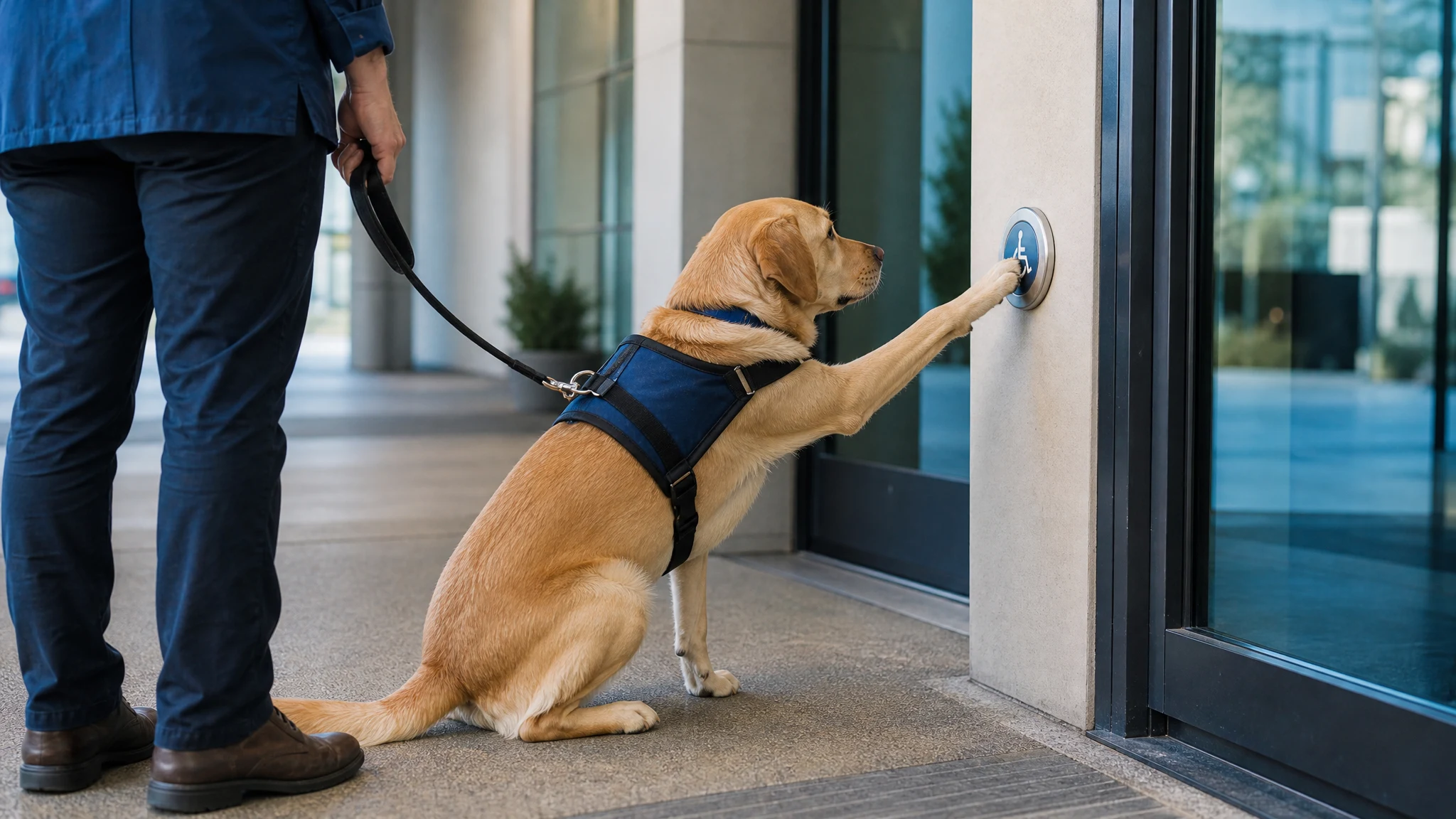
- Mobility disabilities: retrieving dropped items, opening doors, bracing for balance, or pulling a manual wheelchair.
- Seizure disorders or medical conditions: alerting to an oncoming episode, or getting help.
- Psychiatric disabilities such as PTSD: interrupting a panic response, turning on lights, creating space in a crowd, or reminding the handler to take medication.
- Diabetes: alerting to changes the dog has been trained to notice.
These answer the question of what tasks a service dog can do. The list is not closed. What matters is that the dog is trained to do the work, and that the work connects to the disability.
Step 2: Understand why comfort alone is not a task
A dog that makes you feel calmer just by being near you is a comfort to you. That is valuable, but under the ADA it is not work or a task. Emotional support, therapy and comfort animals are not service animals under the ADA.
South Dakota draws the same line in its misrepresentation statute. SDCL 22-35-9 defines a service animal as a dog trained to do work or perform tasks for an individual with a disability, and it says emotional support or deterrence effects do not count as work or tasks.
A trained task is different. Interrupting a panic attack by nudging your hand on cue, or applying steady pressure when the dog notices distress signs, is trained behavior tied to a symptom. Simply being a soothing presence is not.
One more detail: South Dakota's landlord-tenant statute, SDCL 43-32-33, uses a much broader definition that includes emotional support and therapy animals. That is a housing rule. It does not change who counts as a service dog in public places.
Step 3: Choose and define each task
Write each task as a sentence with a trigger and a behavior. For example: "When I drop an item, the dog picks it up and puts it in my hand." Or: "When I begin to show signs of a panic episode, the dog nudges my hand and stays in contact."
Keep the list realistic. Two or three reliable tasks are better than ten shaky ones. Each task should be something you can describe to a staff member in one short sentence, because that is what the ADA's second permitted question asks about.
Step 4: Teach each task with rewards
- Break the task into small pieces. To teach a retrieve, start by rewarding the dog for looking at the object, then touching it with the nose, then mouthing it, then picking it up.
- Mark and reward. Use a clicker or a short word like "yes" the instant the dog does the right thing, then deliver a treat.
- Add the cue or trigger. Once the behavior is reliable, attach a verbal cue or a hand signal. For alert tasks, pair the behavior with the real trigger under safe conditions.
- Build duration and distance gradually. Increase one thing at a time so the dog keeps succeeding.
- Practice in new places. Dogs do not automatically carry a skill from the living room to a store. Repeat the task in new rooms, then outside, then in quiet public spaces.
- Fade treats slowly. Move to intermittent rewards, but keep paying well for hard work.
Avoid shock, prong or choke collars, alpha rolls, scruffing and any dominance-based method. They are not consistent with AVSAB guidance and they can damage the trust a working team depends on.
Step 5: Build public manners alongside the tasks
A task-trained dog still needs steady behavior in public. Work on these skills in parallel:
- Walking on a loose leash without pulling.
- Settling under a table or beside a chair for long stretches.
- Ignoring food, other dogs and people who try to pet or call it.
- Staying calm around carts, doors, elevators and sudden noises.
- Staying housebroken, with reliable toilet habits on a schedule.
South Dakota's statute for handlers adds a practical reason to take this seriously. Under SDCL 20-13-23.2, the handler is liable for damage the animal does to the premises of a covered place.
Step 6: Use the public access test as a benchmark
A public access test is a structured way to check whether a dog behaves well enough in public. Assistance Dogs International (ADI), the accreditation body for assistance dog programs, publishes a public access standard that many programs use as a reference point.
For you, it is a training benchmark. It can show gaps you might not notice on your own, such as a dog that sniffs displays or loses focus when a cart passes. Check ADI directly for the current test items and scoring, because the exact wording can change.
It is not a legal requirement. The ADA does not require a public access test, a certificate, an ID card or any registration. There is also no official service dog registry. Online registration or an ID card is not legal proof that a dog is a service dog, and you should not rely on one.
How to run a practice test
- Choose a place where dogs are allowed to practice or where the owner has agreed to the visit.
- Bring a friend to watch and take notes, or record the session if the setting allows it.
- Walk the route you would normally take: entrance, aisles, a pause in line, a seat, an exit.
- Note every slip, such as pulling, sniffing, barking, soliciting attention or losing focus.
- Go back to your training log and work on the weak points before trying again.
What South Dakota law says about access
Under SDCL 20-13-23.2, a person with a disability may be accompanied by a specially trained service animal into the places listed in SDCL 20-13-23.1. Those include hotels, lodging, amusement or resort places and other places open to the public. The place may not charge an extra fee for the animal. An owner or employee of a covered place who fails to comply commits a Class 2 misdemeanor, according to the South Dakota Legislature.
When it is not obvious what the dog does, the ADA lets staff ask only two questions: whether the dog is a service animal required because of a disability, and what work or task the dog has been trained to perform (ADA.gov Service Animals FAQ). Staff may not ask for paperwork or a demonstration, and a clear one-sentence answer about the task is usually enough.
Dogs in training
This is a point where owner-trainers are often confused. SDCL 20-13-23.2 gives access to a service animal trainer bringing an animal in training, if the animal wears an identifying collar and leash, harness or cape. Under SDCL 20-13-1, the trainer is a person who trains service animals as an employee, contractor or volunteer of a nationally recognized service animal training program, and a dog counts as in training only after basic obedience and housebreaking.
That means this is not an open right for every private owner-trainer. Read the current statute text on the South Dakota Legislature website, or ask the agency below, before you assume your dog in training can enter a business.
What not to do: misrepresentation
SDCL 22-35-9 says a person may not intentionally misrepresent an animal as a service animal, directly or through statements or conduct, to gain privileges they know they are not entitled to. A violation is a Class 2 misdemeanor. A pet or an emotional support animal should not be presented as a service dog.
Common mistakes to avoid
- Calling comfort a task. If the only benefit is that the dog is soothing to be around, it does not meet the ADA definition.
- Treating a test as a license. Passing a practice test does not create legal status, and failing one does not remove the rights the law gives a trained service dog.
- Buying a certificate or ID. It is not required and it is not proof.
- Training only at home. Skills often fall apart in a new place unless you practice there.
- Skipping rest. A tired or stressed dog makes more mistakes. Keep sessions short and end on a win.
- Picking tasks that do not match the disability. Each task should clearly connect to a need you can name.
Tips for steadier progress
- Keep a log with the date, place, task and result so you can see patterns.
- Work on one new skill at a time and mix in easy wins.
- Visit quiet places before busy ones.
- Learn the two permitted questions and practice a short, clear answer about your dog's tasks.
- If a particular program placed your dog, ask the program what standards it uses.
What results to expect
Progress varies with the dog's temperament, age, health and the complexity of the task. Many teams find that simple tasks such as retrieving can take weeks of regular practice, while reliable public behavior often takes much longer and may continue to need maintenance. Some dogs turn out not to be suited to service work, and that is a normal outcome, not a failure on your part.
Used well, a task list and a practice test may help you see where your dog is strong and where it needs more work. They cannot promise that a dog will succeed as a working partner.
Where to go next
For a broader look at South Dakota statutes, programs and costs, see our guide to service dog training in South Dakota.
This article states the law and is not legal advice. If you believe a business or landlord has denied you your rights, the South Dakota Department of Labor and Regulation, Division of Human Rights, handles complaints. It is at 123 W. Missouri Ave., Pierre, SD 57501, phone 605.773.3681 (TTY 711). Ask the division about filing deadlines, because they are not stated here.