How to Owner-Train a Service Dog in South Dakota: A Step-by-Step Plan
This page explains the law in general terms. It is not legal advice. For a specific situation, contact the agency listed on this site or an attorney.
Many people with disabilities want to train their own service dog. That is allowed. The ADA does not require a service dog to come from a program or a professional trainer. It asks for something more specific: the dog must be individually trained to do work or perform tasks for a person with a disability.
This guide walks through how to train a service dog yourself, one stage at a time. At each stage it explains what South Dakota law says about dogs in training. That part matters, because the state treats a private owner-trainer differently from a trainer working for a recognized program.
An owner trained service dog is a long project. Expect many months, and often a year or two, before a dog is ready for reliable public work. Nobody can promise that a given dog will make it. Some dogs wash out, and that is a normal part of the process.
In this guide
- Key takeaways
- What the law says before you start
- Stage 1: Temperament and health screening
- Stage 2: Foundation obedience
- Stage 3: Socialization
- Stage 4: Task training
- Stage 5: Public access work and your rights
- Sources
Key takeaways
- Owner-training is legal. ADA.gov defines a service animal as a dog individually trained to do work or perform tasks for a person with a disability, and it does not say who must do the training.
- There is no official service dog registry or required certification under the ADA. Do not pay for a registration, ID card or certificate and treat it as legal proof.
- Emotional support, therapy and comfort animals are not service animals under the ADA. The dog needs trained tasks.
- South Dakota's in-training access rule in SDCL 20-13-23.2 covers service animal trainers working with nationally recognized programs. It is not an open right for every private owner-trainer.
- Use reward-based methods, in line with the American Veterinary Society of Animal Behavior (AVSAB). Consider a professional trainer for task work.
- Intentionally misrepresenting an animal as a service animal is a Class 2 misdemeanor under SDCL 22-35-9.
What the law says before you start
Get the legal frame clear first. It shapes every stage that follows.
The federal definition
The ADA.gov Service Animals FAQ says a service animal is a dog that has been individually trained to do work or perform tasks for an individual with a disability. The work or task must relate to the disability. Simply being present, giving comfort or deterring a threat does not meet the definition on its own.
The same FAQ explains that when the need is not obvious, staff may ask only two questions. First, is the dog a service animal required because of a disability? Second, what work or task has the dog been trained to perform? Staff may not ask for paperwork or a demonstration. Knowing this helps you plan what you will say once your dog is working.
The South Dakota definition
South Dakota's misrepresentation statute, SDCL 22-35-9, defines a service animal as a dog trained to do work or perform tasks for an individual with a disability. It says emotional support or deterrence effects do not count as work or tasks. SDCL 20-13-23.2 covers persons with physical, visual, hearing, psychiatric or mental disabilities and refers to a specially trained service animal.
One wrinkle: SDCL 43-32-33, in the landlord-tenant chapter, uses a much broader definition that includes emotional support and therapy animals. The housing section later in this guide explains why that matters.
Dogs in training in South Dakota
This is the part owner-trainers most often misread. Under SDCL 20-13-23.2, a service animal trainer may bring an animal in training into the places listed in SDCL 20-13-23.1, at no extra charge, if the animal wears a collar and leash, harness or cape that identifies it. Under SDCL 20-13-1(18), a trainer is a person who trains service animals as an employee, contractor or volunteer of a nationally recognized service animal training program. Under SDCL 20-13-1(17), a dog counts as in training only after it has completed basic obedience training and is housebroken.
In plain terms, the in-training access rule is written around trainers tied to a nationally recognized program. It does not read as an open right for any private person training their own dog. The wording on trainers should be checked against the official text on the South Dakota Legislature website before you rely on it. If you plan to take a dog in training into businesses, ask the business for permission first and ask the Division of Human Rights (contact details below) how the rule applies to your situation.
The practical result for owners: do most of your early training in places you control, such as home, your yard and private spaces, and in places that have said yes. Once the dog is a trained service dog and you are a person with a disability, the public access rules for handlers apply.
For a wider look at programs, costs and state rules, see our overview of service dog training in South Dakota: laws, programs and costs.
Stage 1: Temperament and health screening
Every later stage gets easier or harder depending on the dog you start with. Screening is where you decide whether this dog, at this age, is a good candidate.
Temperament
Look for a dog that is calm in new places, recovers quickly after a startle, is neutral toward strangers and other dogs, and stays interested in working with you. Warning signs include persistent fear, reactivity, resource guarding, heavy distraction by smells or movement, and high arousal that does not settle.
A dog does not need to be a particular breed. The ADA does not limit service dogs to certain breeds. What matters is that the individual dog is suited to the work, which can be physically demanding and long.
Health
A service dog may work for years, so structure and health matter. Talk with your own veterinarian about vaccines, parasite prevention, hip and elbow concerns for larger dogs, eye and heart screening where relevant, and weight. Ask what is realistic for the tasks you need. For example, a dog that will brace or pull a wheelchair needs sound joints.
Check with the breeder, rescue or club about health testing records and the dog's history. Do not assume a dog is sound because it looks healthy.
Match the dog to your tasks
Write down what you need the dog to do before you commit. A dog for retrieving dropped items and a dog for interrupting panic symptoms may suit different temperaments and sizes. If you are unsure, a professional trainer or an Assistance Dogs International (ADI) accredited organization can help you think it through.
Be willing to change course
Many dogs are a wonderful pet but a poor service dog. Deciding that early is a good outcome, not a failure. It protects the dog from stress and protects you from a dog that is not reliable when you need it.
Stage 2: Foundation obedience
Foundation skills are the base for everything else. They are also what South Dakota's definition of a dog in training points to, since SDCL 20-13-1(17) refers to completed basic obedience training and a housebroken dog.
Core skills to build
- Sit, down, stand and stay, with duration and distance added gradually.
- Name response and eye contact on cue.
- Loose-leash walking and a reliable recall.
- Settle on a mat or under a chair for long periods.
- "Leave it" and polite behavior around food, dropped items and other dogs.
- Calm handling for grooming, vet exams and gear fitting.
- Full house training and a reliable way to go to the bathroom on cue or on a schedule.
Use reward-based methods
Teach with food, toys and praise. Mark the behavior you want, reward it, then make it harder in small steps. This is the approach in line with AVSAB's position on humane training. Do not use shock, prong or choke collars, alpha rolls, scruffing or any dominance-based method. These methods can increase fear and aggression, and a frightened dog is a poor service dog.
Short sessions, many places
Keep sessions to a few minutes and end while the dog is still keen. Practice each skill in a new room, then the yard, then a quiet private place, so the behavior holds up when the setting changes. Build up distractions slowly.
Choose gear that fits
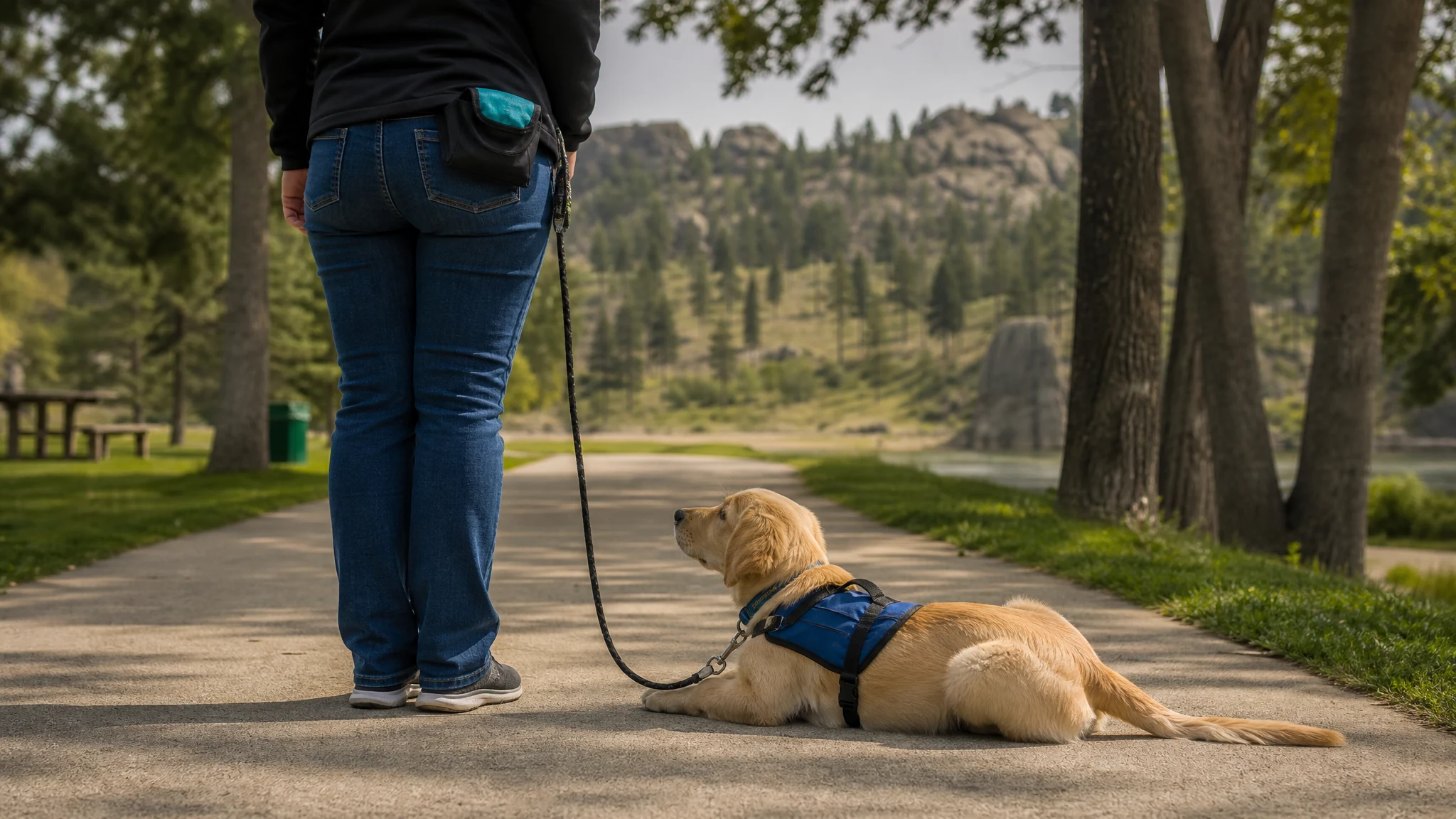
A flat collar or a well-fitted harness and a standard leash work for most dogs. If the dog will wear a vest or cape when it goes into training, introduce it as a normal, pleasant piece of equipment. Under SDCL 20-13-23.2, the identifying collar and leash, harness or cape is part of the rule for animals in training that it covers. A vest does not make a dog a service animal, and no vest is required by the ADA.
Stage 3: Socialization
Socialization means safe, positive exposure to the sights, sounds, surfaces and people the dog will meet in daily life. It is not the same as letting the dog greet everyone. A working dog should learn that most things in the world are boring.
Build a gradual exposure plan
List the places and situations your dog will face: stairs, slick floors, elevators, vehicles, crowds, kids, bikes, carts, loud equipment, sirens and other animals. Introduce each one at a distance where the dog stays relaxed, pay for calm behavior, then move closer over many sessions.
South Dakota has wide-open country and long winters, so include weather and travel. Practice with snow, ice, heat, wind and longer car rides. Check with the venue before visiting anywhere, and respect "no dogs" rules on private property until your legal access is clear.
Where you can practice, legally
Because the in-training rule in SDCL 20-13-23.2 is tied to program-affiliated trainers, an owner-trainer should not assume that a store or restaurant must admit a dog in training. Good options include outdoor public spaces where dogs are allowed, the sidewalk and parking areas, friends' homes, and businesses whose managers have agreed in advance. Ask first and accept a no without argument.
Protect the dog's welfare
Watch for stress signals such as lip licking, yawning, turning away, a tucked tail, panting and refusing treats. If you see them, increase distance and make the task easier. Rest days matter. Overexposure can create a fearful dog.
Stage 4: Task training
Task training is what makes a dog a service dog under the ADA. Good manners alone do not qualify. The dog must be trained to do work or perform tasks directly related to your disability.
What counts and what does not
Examples of tasks that fit the definition include retrieving items, opening doors, bracing for balance, alerting to a sound, interrupting a harmful behavior, or applying pressure during a panic episode. Providing comfort, or simply being a calming presence, does not meet the ADA definition. SDCL 22-35-9 likewise states that emotional support or deterrence effects do not count as work or tasks.
Why a professional trainer helps here
Foundation obedience can be a good fit for owners to learn alongside a class. Task work is harder. Tasks often need to be reliable under stress, taught on cue and off cue, and adjusted to your body and your condition. A professional trainer who uses reward-based methods can help you break a task into steps, fix timing errors and spot problems before they become habits.
When you look for help, ask about the trainer's methods and ask them to explain their approach to reward-based training. Be cautious about anyone who relies on force or promises certain results. Check with the trainer or organization directly about services and fees, since those details are not set by the ADA or South Dakota statute.
A simple way to teach a task
- Break the task into small steps, such as nose touch, mouth hold, carry, then deliver.
- Reward each small step with a marker and a treat.
- Add a cue word or signal once the behavior is steady.
- Add distance, duration and distractions, one at a time.
- Practice in several locations, then in real-life conditions that match how you will use it.
- Keep a simple log of dates, tasks and progress. It helps you track your own training.
Keep your own records
The ADA does not require paperwork, and staff may not demand it. Still, a training log and your veterinary records help you and your trainer see progress. Do not describe an online registration or a purchased certificate as legal proof of anything. The ADA does not have an official registry or required certification.
Stage 5: Public access work and your rights
Public access training prepares the dog to work calmly in stores, offices, clinics and restaurants. Most dogs need many short outings before they are consistent.
Skills to test before relying on the dog
- Walks close and quietly in crowded or tight spaces.
- Ignores food, other dogs and people who try to interact.
- Settles under a table or chair for an extended time.
- Stays clean, housebroken and under control at all times.
- Performs trained tasks even with distractions.
- Stays under your control with a leash, harness or tether, or with voice or signal control if those devices interfere with the task.
Handler access in South Dakota
Under SDCL 20-13-23.2, a person with a disability may be accompanied by a specially trained service animal into the places listed in SDCL 20-13-23.1, which include hotels, lodging, amusement or resort places and other places open to the public, without an extra charge. The handler is liable for damage the animal does to the premises. An owner or employee of a covered place who fails to comply commits a Class 2 misdemeanor, according to the South Dakota Legislature. The page summary shows the section was last amended by SL 2020, ch 71, section 1.
When staff ask the two permitted questions, answer them briefly and plainly. You do not have to explain your diagnosis.
Do not misrepresent a pet
SDCL 22-35-9 says an individual may not intentionally misrepresent an animal as a service animal, directly or indirectly through statements or conduct, to gain privileges they know they are not entitled to. A violation is a Class 2 misdemeanor. News reports say the 2026 bill that created this offense, SB 82, was signed on March 9, 2026 and took effect on July 1, 2026. Check the South Dakota Legislature site for the current text and penalties.
This matters for owner-trainers. A dog that is still in training and has not yet learned a task should not be presented as a working service dog to get into places where pets are not allowed.
Housing
SDCL 20-13-23.4 says a landlord may not prohibit, by lease or otherwise, the keeping of a service animal in a rented or leased residence. A violation is a Class 2 misdemeanor. In the landlord-tenant chapter, SDCL 43-32-33 defines service animal broadly to include emotional support, therapy and assistance animals. SDCL 43-32-34 lets a landlord require reliable supporting documentation unless the disability or need is readily apparent or already known to the landlord.
The housing rules are separate from the ADA rules for public places, so a dog can have housing protections without being an ADA service dog. Check with the Division of Human Rights about how the other landlord-tenant provisions apply to you. For federal housing rules, check HUD directly.
Work
SDCL 20-13-10 makes it an unfair employment practice to discriminate because of disability in hiring, discharge and the terms and conditions of employment. The South Dakota Legislature page does not list a service-animal-specific employment provision, so ask the agency below if you need a dog at work.
Where to take a complaint
If you believe a business, landlord or employer has violated your rights, contact the South Dakota Department of Labor and Regulation, Division of Human Rights, 123 W. Missouri Ave., Pierre, SD 57501, phone 605.773.3681 (TTY 711). Its website is dlr.sd.gov/human_rights. The filing deadline was not confirmed on an official page, so ask the agency how long you have. This guide explains the law in plain terms and is not legal advice.
A realistic timeline
There is no fixed finish line and no exam under the ADA. You decide that the dog is ready when it is reliable at its tasks, stays under control and behaves well in public in the real situations you face. If the dog falters, step back a stage. Retired or washed-out dogs deserve a good home, and many owners start again with a second candidate.
Sources
- ADA.gov Service Animals FAQ
- South Dakota Legislature, SDCL 20-13-23.2
- South Dakota Legislature, SDCL 20-13-1 definitions
- South Dakota Legislature, SDCL 22-35-9
- South Dakota Legislature, SDCL 43-32-34
- South Dakota Legislature, SDCL 20-13-10
- SD Department of Labor and Regulation, Division of Human Rights