Service Dogs in Training in South Dakota: Do They Have Public Access?
This page explains the law in general terms. It is not legal advice. For a specific situation, contact the agency listed on this site or an attorney.
Many people who are raising or training their own service dog ask the same question. Can a dog in training go into stores, restaurants and hotels the way a fully trained service dog can? In South Dakota the answer is narrower than most people expect.
This guide walks through what South Dakota law says about service dog in training rights, who it covers, and what to do if you do not fit the definition. It is a plain explanation of the statutes, not legal advice.
The short answer
The federal Americans with Disabilities Act (ADA) defines a service animal as a dog that has been individually trained to do work or perform tasks for a person with a disability, according to the ADA.gov Service Animals FAQ. That definition is about a dog that has been trained. It does not create a public access right for a dog that is still in training.
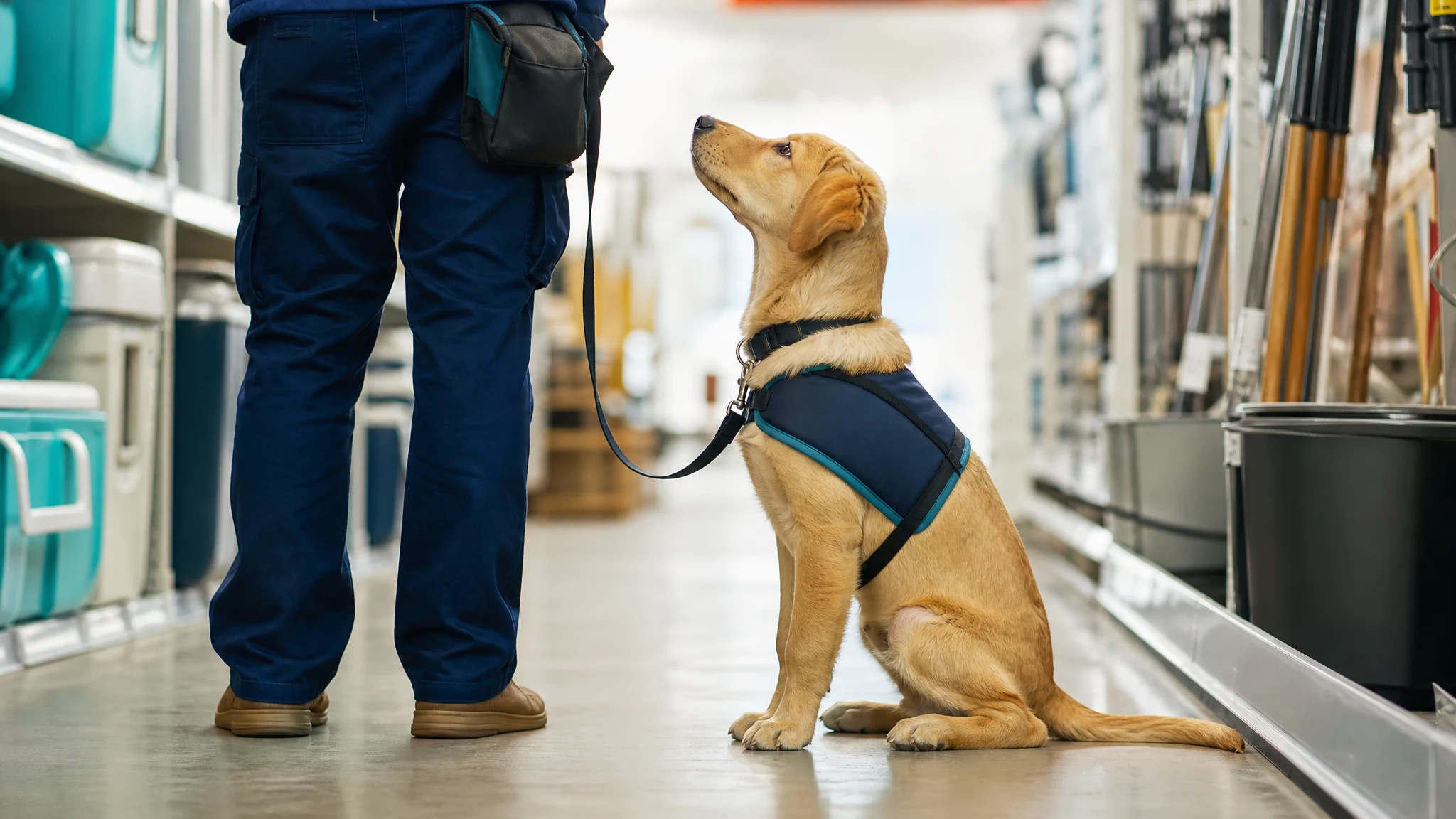
South Dakota adds a state rule. Under SDCL 20-13-23.2, a service animal trainer may bring an animal in training into the public places listed in SDCL 20-13-23.1, with no extra charge, if the animal wears an identifying collar and leash, harness or cape.
The catch is who counts as a trainer. It is not an open right for any private owner-trainer.
What you need before you start
- The text of SDCL 20-13-1, 20-13-23.1 and 20-13-23.2 from the South Dakota Legislature website, so you can read the official wording yourself.
- A clear answer to this question: are you an employee, contractor or volunteer of a nationally recognized service animal training program?
- A dog that has finished basic obedience and is housebroken.
- A collar and leash, harness or cape that identifies the dog as a service animal in training.
- A reward-based training plan, such as treats, praise and toys.
- The contact details for the South Dakota Division of Human Rights, in case you need to ask about a complaint later.
Step 1: Understand what the ADA does and does not cover
The ADA.gov Service Animals FAQ says staff may ask only two questions when a dog's role is not obvious. They may ask whether the dog is a service animal required because of a disability. They may also ask what work or task the dog has been trained to perform.
Those questions assume a dog that already does trained work. A puppy or adolescent dog that is still learning those tasks is not described by the ADA definition. So you cannot rely on the ADA to enter a business with a dog in training.
There is also no official registry or required certification under the ADA. A vest, ID card or online certificate does not change a dog's legal status.
Step 2: Read the South Dakota rule on dogs in training
The in-training rule sits in SDCL 20-13-23.2, which covers service animals, liability and violations. It lets a service animal trainer bring an animal in training into the places listed in SDCL 20-13-23.1. Those include hotels, lodging, amusement or resort places and other places open to the public.
Three conditions apply:
- The person must be a service animal trainer.
- The animal must wear a collar and leash, harness or cape that identifies it.
- There can be no extra charge for the animal's presence.
The statutory summaries available for this topic are short. Before you rely on any detail here, read the current official text of SDCL 20-13-1 and 20-13-23.2 on the South Dakota Legislature website.
Step 3: Check whether you count as a trainer
This is where most private handlers find out the rule does not reach them. SDCL 20-13-1(18) defines a service animal trainer as a person who trains service animals as an employee, contractor or volunteer of a nationally recognized service animal training program.
That wording points to people working with an established program. It does not describe an individual who is training their own dog at home for their own use.
Ask yourself:
- Am I an employee, contractor or volunteer of a program?
- Is that program nationally recognized?
- Am I training the dog as part of that role?
If you cannot answer yes to all three, South Dakota's in-training access provision most likely does not apply to you. If you are unsure, check the statute text and ask the program directly how it handles public outings.
Step 4: Check the dog's readiness
SDCL 20-13-1(17) sets a threshold for what counts as a dog in training. A dog is treated as in training only after it has completed basic obedience training and is housebroken.
A very young puppy that is still learning house manners and basic cues does not meet that definition, even if the person handling it is part of a program. A dog has to be past those basics.
Practical checks before any outing:
- The dog toilets reliably on cue and stays clean indoors.
- The dog walks on a loose leash without pulling.
- The dog settles under a table or at your feet.
- The dog ignores food, other dogs and people without being corrected harshly.
Step 5: Use identifying gear
Under SDCL 20-13-23.2, the dog must wear a collar and leash, harness or cape that identifies it. A plain walking harness with no marking does not meet the wording.
Gear does not create the right on its own. A vest on a dog whose handler is not covered does not turn the outing into protected access. It can also cause problems, which is covered under common mistakes below.
Step 6: Know what happens if you are not covered
If you are a private owner-trainer, South Dakota law does not grant you public access with a dog in training. In practice, that means the business decides.
- Ask permission first. Call or speak to a manager before you arrive. Many owners will say yes to a well-behaved dog, but they are free to say no.
- Choose pet-friendly places. Outdoor patios, pet supply stores and outdoor public spaces that allow leashed dogs are good practice settings. Check each place's posted rules.
- Accept a no politely. If staff decline, leave calmly. Arguing about a right that may not exist can damage relationships with the business and with your dog's future handlers.
- Build skills elsewhere. Home, yards, quiet parks that allow dogs and friends' homes are good places for early work.
Step 7: Do not misrepresent your dog
SDCL 22-35-9 deals with misrepresentation of a service animal in a public accommodation. It says an individual may not intentionally misrepresent an animal as a service animal, directly or indirectly through statements or conduct, to gain privileges they know they are not entitled to. A violation is a Class 2 misdemeanor.
The same statute defines a service animal as a dog trained to do work or perform tasks for an individual with a disability. Emotional support or deterrence effects do not count as work or tasks. News reports say the 2026 law that created this offense (SB 82) took effect on July 1, 2026. Read the statute for the current wording and penalties.
Putting a service dog vest on an untrained pet, or telling staff a dog is a fully trained service dog when it is not, could fall under this rule. Be honest about where your dog is in training.
Step 8: Know the rules once the dog is fully trained
Once a dog is trained to do work or tasks for a person with a disability, the ADA and South Dakota law apply in a different way. Under SDCL 20-13-23.2, a person with a disability may be accompanied by a specially trained service animal into the places listed in SDCL 20-13-23.1 without an extra charge. The handler is liable for damage the animal does to the premises. An owner or employee of a covered place who fails to comply commits a Class 2 misdemeanor.
For housing, SDCL 20-13-23.4 says a landlord may not prohibit the keeping of a service animal in a rented or leased residence. SDCL 43-32-33 uses a broader definition for landlord-tenant purposes that includes emotional support and therapy animals. SDCL 43-32-34 lets a landlord require reliable supporting documentation unless the disability or need is readily apparent or already known to the landlord.
If you believe a business or landlord has refused you unlawfully, contact the South Dakota Department of Labor and Regulation, Division of Human Rights, at 123 W. Missouri Ave., Pierre, SD 57501, phone 605.773.3681 (TTY 711). Ask the agency about filing deadlines, because the time limit was not confirmed on an official page.
Tips for training in public the right way
- Start with short, easy outings and end before the dog is tired or stressed.
- Reward calm behavior often. Use treats, praise or a favorite toy. Reward-based methods are in line with the American Veterinary Society of Animal Behavior (AVSAB).
- Keep the dog close and out of aisles, doorways and other people's paths.
- Bring a mat or small towel so the dog has a clear place to settle.
- Take notes on what the dog finds hard, such as slippery floors or crowds, and practice those in small steps.
- Talk with your program, if you have one, about how it expects you to handle public outings.
Common mistakes to avoid
- Assuming a vest creates access. There is no official registry or certification, and gear alone does not give legal rights.
- Buying a registration or ID card. An online registration is not legal proof of anything under the ADA or South Dakota law.
- Treating the in-training rule as open to everyone. The state definition of trainer is tied to a nationally recognized program.
- Taking a dog out too early. The statute counts a dog as in training only after basic obedience and house training are complete.
- Mixing up service dogs with emotional support animals. Under the ADA, emotional support, therapy and comfort animals are not service animals. The broader landlord-tenant definition in SDCL 43-32-33 is a separate rule for housing.
- Using harsh tools. Do not use shock, prong or choke collars, alpha rolls, scruffing or dominance methods. They work against a calm, confident working dog.
- Arguing with staff. If a business says no, thank them and leave. You can follow up with the agency listed above if you believe your legal rights were denied.
What to expect
If you are a trainer with a recognized program and you follow the rules, you may be able to take a dog that has finished basic obedience into covered public places while it wears identifying gear. How staff respond will vary, so carrying program information and staying polite can help.
If you are a private owner-trainer, you will most likely rely on permission and pet-friendly locations while the dog is in training. That may feel slower, but it lets you build solid skills without legal risk. Results depend on the dog, the handler's consistency and the places available, and no outcome can be promised.
Once the dog is trained to do specific work or tasks for a disability, the access rules in SDCL 20-13-23.2 and the ADA can apply. That is the point where public access becomes a right instead of a favor.